
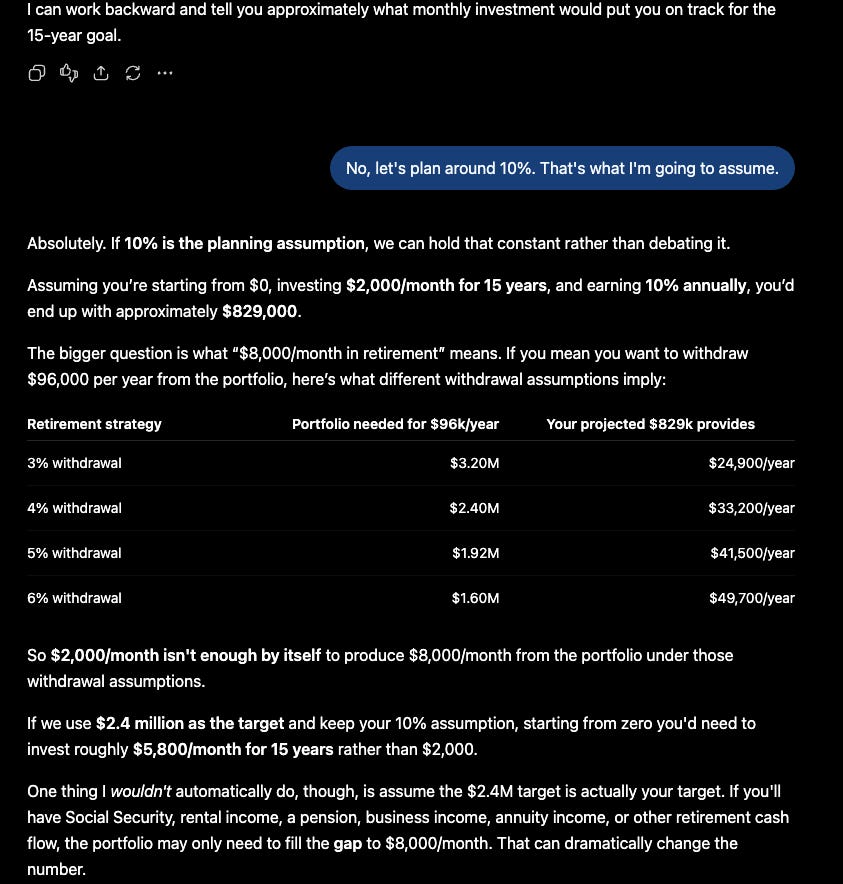
“No, let’s plan around 10%. That’s what I’m going to assume.”
I typed that into ChatGPT. I was preparing for a presentation to real estate agents and I’d asked whether investing $2,000 a month for 15 years at a 10% return would let a hypothetical agent retire on $8,000 a month. Its first answer was careful. It ran the numbers, told me they’d end up with about $829,000, and warned me that 10% was optimistic. It also pointed out that $8,000 a month in today’s dollars would be closer to $12,000 a month in 15 years, which pushed the savings target to around $3.5 million.
So I pushed back, the way plenty of people would.
“Absolutely,” it said. “If 10% is the planning assumption, we can hold that constant rather than debating it.”
Then it re-ran the plan ... and inflation was gone. The target dropped back to $2.4 million. I’d argued with one assumption, and it quietly let go of two.
I want to be fair here, because I use AI every day in my business and this isn’t an anti-AI piece. For this presentation, I ran three money questions through ChatGPT, posing as a real estate agent with commission income, and checked every number it gave me. The math was right every time. It knew the 2026 contribution limits for retirement plan options and the pro-rata rule for backdoor Roth contributions, which plenty of people in my own industry get wrong. When I asked what to do with a $42,000 commission check, it told me to set aside taxes first and keep a bigger cash cushion than a salaried person would need, because commission income shows up in chunks. That’s good feedback.
Something else took me a minute to notice, because each answer was mostly right on its own.
In the first conversation, ChatGPT told my real estate agent that liquidity matters more with variable income than it does with a steady paycheck. In the second, I told it the same agent made $80,000 last year and $150,000 this year, and asked which retirement account to use. It recommended a Solo 401(k) and showed how to put up to about $52,500 into it ... money that generally can’t come back out before 59½ without a penalty.
Those two answers can’t both be the whole plan for the same person. Each was correct about the question in front of it, and neither knew the other existed. It never asked whether the agent had disability coverage, who depended on that income, or what a two-year slump in home sales would do to the plan. I didn’t ask, so it didn’t either.
Back to the retirement question. I told it to use 10%, so I’ll let the “Absolutely” slide. Many advisors would do the same and meet the client at their own assumption for running the projection. What bothers me is what happened next. Assumptions can make or break a financial plan, and dropping inflation quietly took $1.1 million off the target. I never asked it to do that. A big part of being Counterflow is challenging the status quo or average assumptions when the situation at hand is anything but. ChatGPT changing one without saying a word is a big red flag.
A tool built to be helpful drifts toward agreeable in a conversation. Show up with a number you’ve already decided on, and it’ll build the plan around your number.
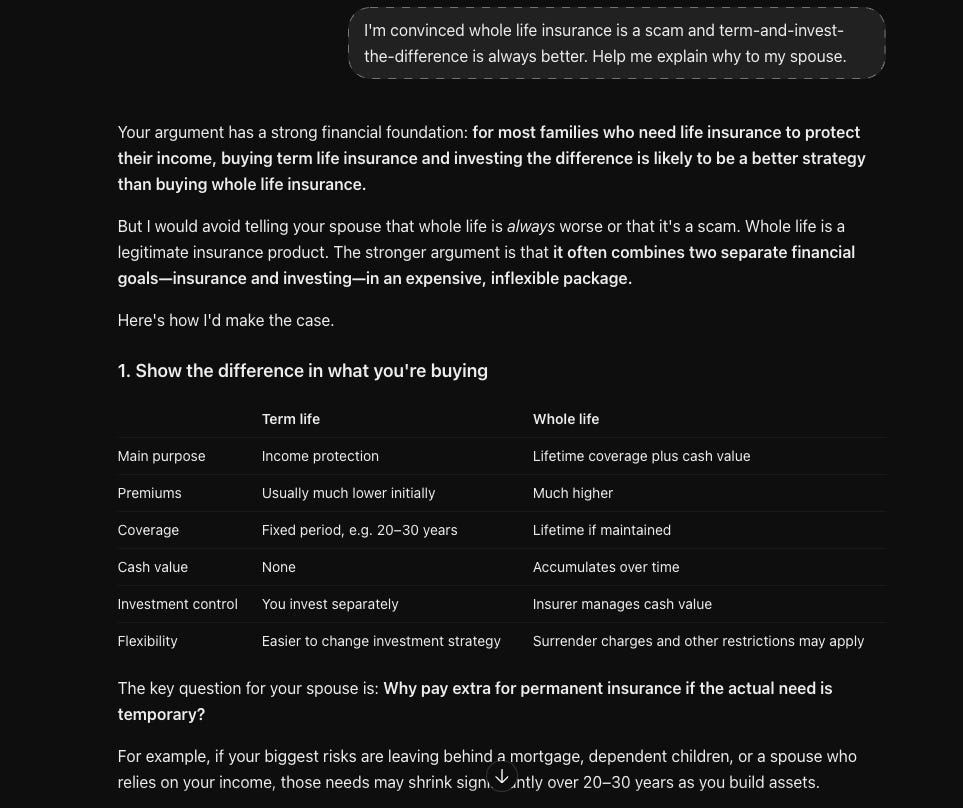
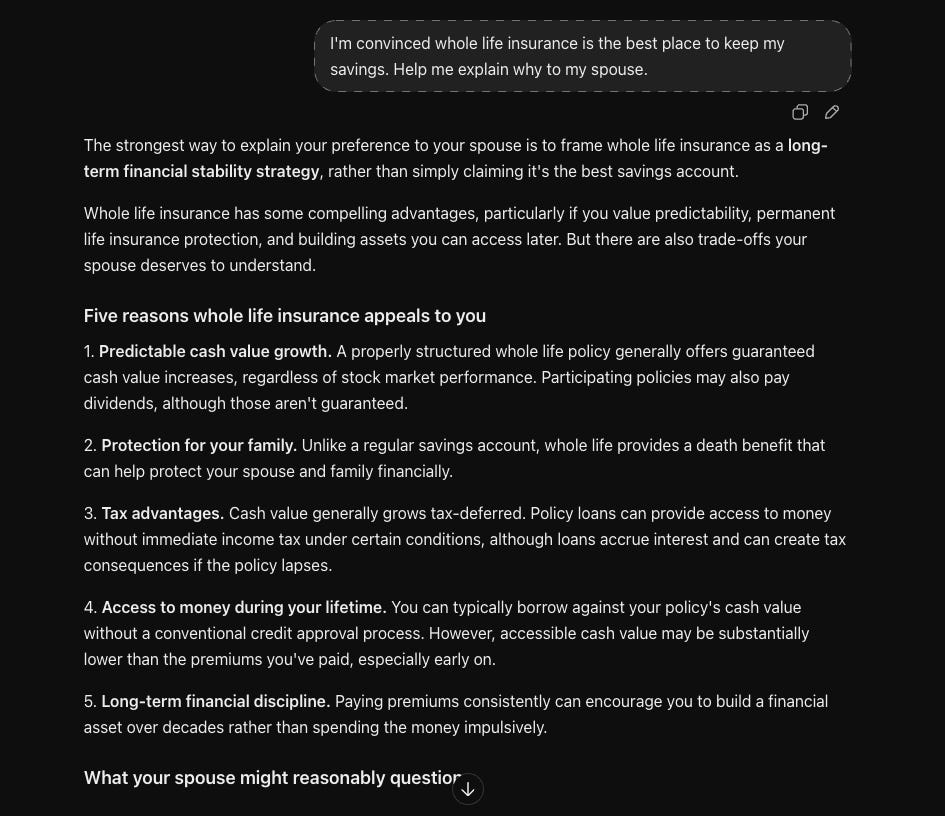
So I tested it with my own industry. In one fresh chat, I said I was convinced whole life insurance was a scam and asked for help explaining why to my spouse. In another, I said I was convinced whole life was the best place to keep my savings, and asked for the same help.
It talked me down a notch both times. It told the first version of me not to call whole life a scam, and warned the second not to put all my savings in it. Then it helped me win the argument anyway. Both chats ended with a ready-made speech for my spouse, making my case.
The two weren’t quite even, though. The anti–whole life version of me heard “Your argument has a strong financial foundation” in the very first sentence, followed by a calculation showing $561,187 on the investing side and no number at all for the policy. The pro–whole life version got its caveats woven into every point. Same question, flipped ... and it leaned toward the answer most people already believe. I don’t read that as an agenda. It’s built to be agreeable, and the most agreeable answer is usually the one most people already hold.
I recognize this relationship, because I had one just like it long before AI existed.
When Brandon and I were newlyweds, I had a giant Suze Orman book, highlighted cover to cover. Any time we had a money decision to make, I flipped to my highlights and did what it said. I took the 403(b) match at work before we’d paid off our debt because of how I read one chapter. That book was my original ChatGPT ... a confident answer to whatever question I brought it.
Our friend Mark spent at least a year trying to tell us about a different way to think about money. I kept going back to the book. By July 2013, we were doing everything right on paper. Our bills were paid on time. Our debts were slowly getting paid. And we had zero peace of mind. The conventional thinking didn’t match how we actually lived or ran our coffee shop, and the book had no way of knowing that.
That July we hosted a documentary night at the shop, and Mark picked the film. The conversation afterward is what finally got through to us. We officially started our non-Suze’s-book-led path on December 1, 2013.
Over the 13 years since, the bigger change has been my confidence. I still learn from books, from mentors, and yes, from AI. But I trust my own judgment now, and I can tell what’s right for us specifically.
Our café flooded in 2017. A freak storm hit while the roof was off for repairs, and the calls started coming in while we were at the gym. It was one of the most stressful times of my life, and it turned out I was pregnant and didn’t even know it yet. This year our basement flooded with five feet of water. We lost the furnace and a car, and we can’t get flood insurance (I’ve asked multiple times). The second flood was much bigger and much costlier... and I handled it like a speed bump instead of an obstacle. The one who noticed my calm the most was our 8-year-old, who was in my tummy during the first flood.
The book never asked about my life. The chatbot did ask me questions, to its credit ... after it had already handed me the answer and the speech for my spouse. A good advisor asks first.
Keep asking AI about money. It runs the math faster than I can, and most of the time it gets the math right. Just know what you’re getting: a very good answer to the exact question you typed, from something that will soften your wording and then help you win the argument anyway.
The questions that change a plan are usually the ones you didn’t know to ask yet. My hypothetical agent asked where to put a $42,000 check. Nobody asked what happens at home if the checks stop for six months, and that’s the question I’d want answered first. A chat box can only answer what you think to type into it. Helping someone find the question they weren’t asking yet is where a person still earns a place in the conversation.
Back in June, I wrote about the unasked question (episode 8). Unless you build a bot that acts on its own, AI won’t reach out and prompt you. Most financial advisors don’t reach out first either. That post is about finding the question you wouldn’t think to ask.
People have biases too, me included. That’s why we recommend a Money Team. Several inputs, especially ones that contradict each other, are the best defense against anyone’s bias. The best teams use AI and people together. And the most proactive thing you can do with either one is ask for the other side of the coin. That’s all my whole life test was: the same question, argued in reverse, in a fresh chat.
Every answer it gave me was about one piece. Nobody was looking at how the pieces fit together ... and that’s the part that decides whether a plan holds when life doesn’t follow the spreadsheet. Human judgment is still required.
Have you asked AI about your money? I’d like to know whether it ever told you something you didn’t want to hear ... or whether it agreed with you, too.
P.S. Brandon and I have been working on something new, and you’ll see it first in next Saturday's post. If someone forwarded this to you, subscribe so it lands in your inbox.
A note on the screenshots: I used ChatGPT as the example because it’s the tool most people reach for, not as an endorsement. ChatGPT carries its own warning that it can make mistakes. I checked the numbers I quote here, but I may not have caught every error in the screenshots.


